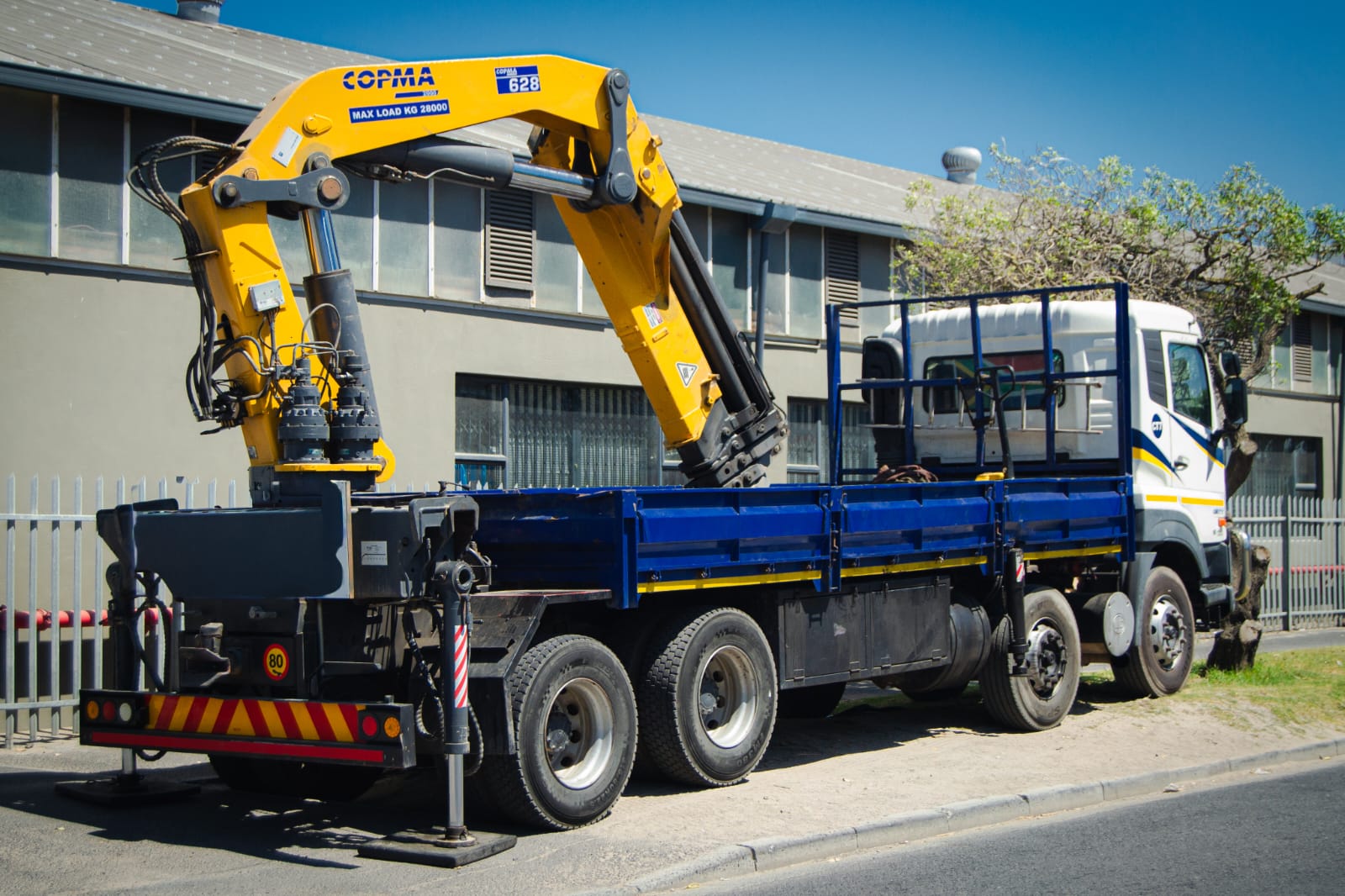
What is a crane truck?
A crane truck-also referred to as a rigid crane truck, truck-mounted crane, or HIAB truck (after one of the most recognised brands)-combines a commercial truck chassis with a hydraulic crane bolted or welded directly into the vehicle's frame.
Unlike a dedicated mobile crane, which is designed purely for lifting and requires a separate vehicle to transport loads, a crane truck performs both functions: it drives to the job, lifts the load, carries it on its own flatbed or dropside body, and deposits it at the destination. This makes it one of the most self-sufficient tools available for light-to-medium lifting work.
In their standard configuration, crane trucks are road-legal and can travel between sites on public roads without special permits-unless the cargo itself constitutes an abnormal load.
How a crane truck works
The crane is powered by the truck's hydraulic system, driven either by a power take-off (PTO) unit from the gearbox or by a dedicated hydraulic pump. The operator controls the crane from a remote handset or a ground-level control station beside the truck.
Before any lift, the operator deploys outriggers-extendable stabilising legs on either side of the chassis-to prevent the vehicle from tipping under load. The outriggers transfer the weight of the load through the truck's frame directly to the ground, bypassing the suspension and tyres entirely.
A safe working load (SWL) indicator alerts the operator if the load approaches the crane's rated capacity for a given radius. Modern units include automatic overload cutouts that prevent the crane from operating outside its safe envelope, and a load chart mounted in the cab specifies the maximum allowable lift at every boom angle and extension.
Types of crane trucks in South Africa
Knuckle-boom (articulated) crane trucks
The knuckle-boom crane is by far the most common type on South African roads. Its boom folds at one or more articulated joints-like a human finger-allowing it to retract into a compact position that keeps the truck within normal road-legal dimensions. When deployed, the multiple joints give the operator precise placement control, especially in confined yards and urban sites.
Knuckle-boom cranes are rated in tonne-metres (t/m), which expresses the relationship between the load weight and the horizontal distance from the truck at which it is held. A higher t/m rating means the crane can either lift a heavier load close in, or a lighter load further out. Operators must always consult the load chart before rigging up.
Most knuckle-boom units accept a wide range of specialist attachments-grabs, rotators, man-riding baskets, brick clamps, pipe tongs-significantly extending their usefulness beyond basic hook-and-lift work.
Telescopic boom crane trucks
A telescopic boom extends outward in straight sections rather than folding at joints. These units generally achieve greater vertical reach than knuckle-boom cranes of equivalent frame size, and they handle lifts requiring a direct overhead approach more naturally. The trade-off is a larger stowed profile and reduced manoeuvrability when working close in or under structures.
In South Africa, telescopic truck-mounted cranes are most often found on heavier rigid chassis-26-tonne GVM trucks-where greater reach and higher capacity justify the additional size.
Loader cranes
A loader crane is a lighter knuckle-boom variant designed primarily for self-loading and unloading of the truck's own cargo-pallets, drums, packaged building materials, and light machinery. They are almost always mounted behind the cab to keep the full load bed free. You will see them frequently on brick-delivery trucks, municipal service vehicles, and agricultural supply trucks across South Africa.
Forestry and grab crane trucks
A specialist category fitted with a heavy-duty rotating grab rather than a hook. Purpose-built for handling timber, scrap metal, and bulk recyclables, these units allow rapid loading without manual rigging. They are an increasingly common sight at timber processing facilities in the Western Cape, KwaZulu-Natal Midlands, and Mpumalanga escarpment, where mechanised loading dramatically increases throughput.
Behind-cab mounting vs rear mounting
Where the crane sits on the chassis has a significant practical effect on what the truck can do:
|
Behind-cab |
Rear-mounted |
| Load bed |
Full-length and unobstructed |
Reduced-crane occupies the rear section |
| Best for |
Carrying full pallets or long loads |
Spotting and off-loading at destination |
| Working direction |
Forward and to both sides |
Rearward and to both sides |
| Typical use |
Brick delivery, agricultural supply |
Machinery spotting, container placement |
Industries that use crane trucks in South Africa
Construction and civil engineering
Construction is the primary market. A truck-mounted knuckle-boom handles the continuous material flow that busy sites demand-bricks, blocks, roof trusses, steel sections, scaffolding frames, precast concrete elements, and drainage products. Because the crane travels with the truck, loads arrive on site and are placed exactly where needed without waiting for secondary equipment.
On multi-storey projects in Cape Town, Johannesburg, and Durban, crane trucks routinely lift materials to upper-floor level through window and slab openings, reducing manual handling time and injury risk significantly.
Agriculture and agri-processing
Farms regularly need to move heavy equipment across terrain that would challenge a standard mobile crane. Tractors, combine harvesters, irrigation pumps, grain silos, and storage tanks are all routine crane truck jobs. The vehicle's road-legal size means it can travel along farm access and district roads without permits, and the knuckle-boom's reach allows operation in confined farmyard spaces. Agri-processing facilities use crane trucks for machinery installation and periodic removal of heavy processing equipment during maintenance seasons.
Logistics, distribution, and container handling
The ability to self-load and self-offload makes crane trucks a natural fit for logistics where forklift access is not guaranteed. A truck can collect heavy goods, load them with the on-board crane, drive to a farm, warehouse, or yard with no forklift on site, and off-load without assistance. In the container-moving sector, heavier crane truck configurations place 10-foot and 20-foot containers-site offices, ablution units, refrigerated containers-in locations a dedicated container handler cannot easily reach.
Utilities and municipal services
Eskom, municipal electricity departments, and water utilities operate large crane truck fleets for network maintenance. Transformer handling, pole erection, cable reel management, and valve replacement all happen from crane trucks-often in live traffic or on unpaved roads where a large mobile crane is unsuitable. The compact footprint of a behind-cab knuckle-boom is critical in urban streetworks, where working within a lane closure and avoiding overhead powerlines demands precise reach rather than raw lifting capacity.
Forestry and recycling
Grab-equipped crane trucks handle mechanised loading and offloading of timber, scrap metal, and recyclable materials. The rotating grab replaces the hook, allowing rapid bulk handling without manual rigging-critical for high-throughput forestry operations in regions like the Mpumalanga escarpment and KwaZulu-Natal Midlands.
Crane truck vs mobile crane: which do you need?
The two types of equipment overlap in the light-to-medium lifting range. Choosing correctly avoids both under-specifying (using a crane truck when the job truly needs a dedicated mobile) and over-specifying (mobilising a large mobile crane for work a crane truck handles easily).
|
Crane Truck |
Mobile Crane |
| Primary function |
Lift and transport in one vehicle |
Dedicated high-capacity lifting |
| Typical capacity |
1 – 30 tonnes depending on configuration |
5 – 500+ tonnes |
| Setup time |
Minimal-outriggers only, ready in minutes |
Longer-counterweights, rigging, lift plan |
| Site access |
Road-legal; navigates tight yards and farm roads |
Needs clear access, turning space, firm ground |
| Lift height |
Moderate-suited for most site work |
High-suited for tall structures and towers |
| Best suited to |
Deliveries, maintenance lifts, light machinery |
Structural steel, large plant, engineered lifts |
If your lift falls in a grey zone, BrightRig's team will assess the job and give an honest recommendation. Getting the equipment right the first time is far less disruptive than having to change vehicles mid-project.
Common crane truck brands in South Africa
South Africa has strong dealer representation for several international crane brands:
- Fassi-one of the most widely seen brands on South African roads. The Italian manufacturer's range runs from light loader cranes to heavy-duty multi-boom configurations, with spare parts available nationally.
- Hiab (Cargotec)-highly popular in the construction delivery and brick-and-block sector. The Hiab XCL series is a frequent specification on new dropside truck builds.
- Palfinger-a strong presence in logistics and container-handling. Palfinger's PK and PC series are known for build quality and longevity in demanding environments.
- Atlas (Atlas Maschinen)-commonly mounted on UD Quester, MAN, and Mercedes-Benz Actros platforms. Good availability of used units makes Atlas practical for fleet buyers and plant hire companies.
- Penz / Kesla-specialist brands in the forestry and grab-crane segment, increasingly present at timber processing facilities in KwaZulu-Natal and Mpumalanga.
South African regulations & compliance
Operating a crane truck on any South African worksite involves compliance across several overlapping frameworks. Non-compliance exposes the operator and employer to legal liability, and insurance claims can be invalidated if required certifications are absent.
- Occupational Health and Safety Act (Act 85 of 1993)-the primary legislation governing workplace safety. Any person operating a lifting machine must be a trained and certificated lifting machine operator (LMO). The employer bears direct responsibility for ensuring this.
- Driven Machinery Regulations (DMR)-promulgated under the OHS Act. The DMR requires all lifting machines to undergo periodic inspection and load testing by an appointed lifting machinery entity (LME), with inspection records kept on site.
- SANS 10085-The safe use of mobile cranes-covers truck-mounted cranes and sets out requirements for pre-use inspection, operator competency, load chart compliance, lift planning for non-routine lifts, and ground condition assessment before outrigger deployment.
- Annual load testing-all lifting machines must be load-tested at intervals not exceeding twelve months, conducted by or under the supervision of a registered LME. A valid certificate of inspection must be in place before the machine operates.
- Operator LMO certification-operators must hold a valid LMO certificate from an accredited training provider specifying the class of lifting machine they are permitted to operate.
- Abnormal load permits-when a crane truck transports cargo that takes the combination outside normal road-legal dimensions or mass limits, an abnormal load permit from the relevant provincial road authority is required before travel. Routes, timings, and escort requirements are specified in the permit.
BrightRig maintains full compliance across its fleet. All operators hold current LMO certifications, all crane trucks carry valid load test certificates, and abnormal load documentation is prepared in advance where required.
Choosing the right crane truck for your job
Working through these five factors before you call a hire company will ensure you get the right equipment from the start:
- Load weight and dimensions-the heavier and bulkier the load, the higher the required tonne-metre rating. Always choose a crane with capacity to spare rather than working at its limit.
- Required reach and height-a knuckle-boom's capacity reduces as the boom extends. A lift that seems straightforward can push the limits if the placement point is far from the truck, so confirm the working radius before booking.
- Site access and ground conditions-are there overhead obstacles such as powerlines, roof structures, or trees? Is the ground firm enough for outrigger pads, or will steel spreader plates be needed? These factors determine whether a standard crane truck can access the lift zone at all.
- Whether the load needs to be carried-if you are only lifting in place, almost any crane truck in the right capacity range works. If the load also needs to ride on the flatbed between locations, you need a behind-cab configuration that leaves the load bed clear.
- Specialist attachments-does the job require a brick clamp, pipe tong, man-riding basket, or rotating grab? Confirm the attachment is available before confirming the booking.
If any of these factors are unclear, describe the job to BrightRig and our team will spec the right equipment. We have encountered most scenarios and can identify potential constraints before they become problems on the day.
Not sure which crane truck you need?
Describe your job to our team and we'll recommend the right equipment and have a quote to you within 48 hours.
Get a free quote →
Or WhatsApp us for immediate availability