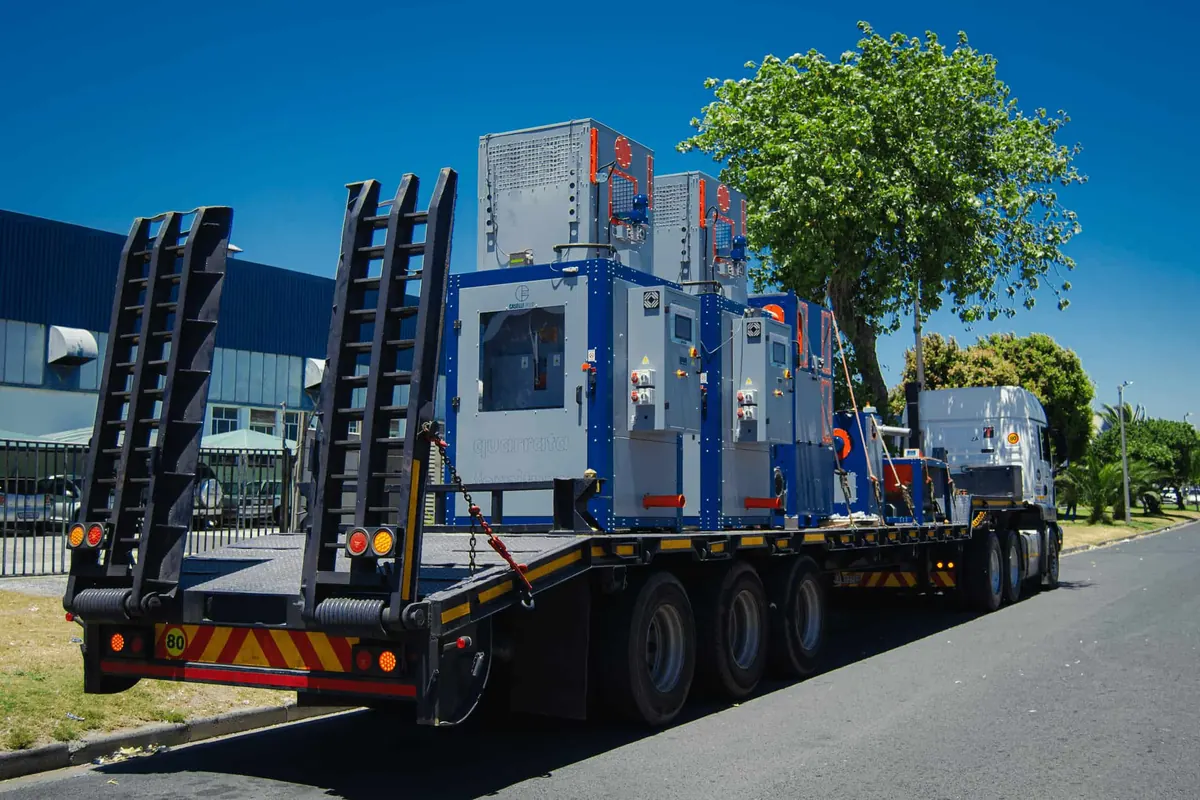
Abnormal Load Permits in South Africa: How They Work
When you need a permit, the permit types, escort and travel conditions, what the application needs, and how to keep permits from delaying your project.
Published 16 September 2026 · 9 min read
In This Article
What counts as an abnormal load?
An abnormal load is an object that, for practical purposes, can’t be divided and can’t be carried on a vehicle without exceeding the legal limits for dimensions or mass. Think transformers, large machines and presses, boilers, tanks, crushers, earthmoving equipment, prefabricated steel sections, and long structural members.
The key word is indivisible. A permit will only be considered where there’s no reasonable way to move the load legally, meaning it can’t be split into smaller loads without disproportionate effort, cost or risk of damage. If a machine can be partly dismantled to bring it within legal limits, the authorities expect that to be considered first.
The common legal limits that trigger an abnormal load permit are:
| Limit | Legal maximum | Typical loads that exceed it |
|---|---|---|
| Width | 2.6 m | Wide machinery, tanks, excavators, modular structures |
| Height (from the road) | 4.3 m | Tall presses, vessels, transformers on a trailer |
| Length | 12.5 m (rigid vehicle), 18.5 m (articulated vehicle), 22 m (other combinations) | Beams, columns, silos, long conveyor sections |
| Mass | Legal axle, axle-unit and combination mass limits | Heavy transformers, mill components, large generators |
Exceeding any one of these is enough to need a permit. Many industrial loads exceed several at once, which affects the conditions attached to the permit.
The law and who issues permits
Abnormal loads are moved under a written exemption granted in terms of Section 81 of the National Road Traffic Act (Act 93 of 1996). The technical requirements (dimensions, mass, escorts, warning signs and speeds) are set out in TRH 11: Dimensional and Mass Limitations and Other Requirements for Abnormal Load Vehicles. A companion document, the Administrative Guidelines for Granting of Exemption Permits, covers how permits are applied for and issued.
Permits are issued by provincial permit offices. The guidelines are national, but the issuing authority can deviate from them or add requirements based on the specifics of each application. For a trip that crosses provincial borders (for example, moving a machine from Gauteng to the Western Cape), each province along the route is involved unless the load qualifies for a countrywide permit (see below).
The permit is normally applied for by the transport operator carrying the load, because it’s tied to specific vehicles, a specific route and a specific person in charge of the trip.
Types of abnormal load permits
Trip permits
A trip permit covers a single journey, or a set of similar journeys, on a specified route. Its validity depends on the distance: roughly two days for trips up to 100 km, increasing with distance to around six days for the longest trips, and up to ten days where a traffic officer escort is required. This is the permit most once-off industrial moves use, such as a machine relocation or a transformer delivery.
Route-period and area-period permits
For operators moving similar abnormal loads repeatedly, a route-period permit covers a named route and an area-period permit covers a defined area. Both can be valid from one week up to twelve months. They suit ongoing work such as regular deliveries of oversize equipment to a mine or construction project.
Countrywide permits
For certain smaller dimensional loads, one province can issue a countrywide permit on behalf of the other provinces on the route. These come with strict limits: no mass exemption, a maximum laden height of 4.6 m, and a maximum validity of three months. Heavy or very large loads don’t qualify and are handled province by province.
What a permit application needs
The exact forms differ between provinces, but a complete abnormal load application generally needs:
- Load details: a description of the item, its exact dimensions, mass, and ideally drawings showing the centre of gravity
- Vehicle details: registrations, the vehicle combination and axle configuration, and the loaded dimensions and axle masses
- The route: origin, destination, and the specific roads to be used
- Travel dates that avoid embargo days
- Route clearances where required, such as structural assessments of bridges for very heavy loads. For vehicles up to 125,000 kg laden, a structural route clearance may be waived if the carrier specifies the route.
- Supporting calculations, such as stability calculations for tall or top-heavy loads
On the day of the move, the permit’s conditions carry into the cab. The loaded vehicle is typically weighed at a weighbridge and the axle-mass certificate kept in the vehicle. Each vehicle in the combination needs a valid roadworthy certificate, and a named person in charge must stay with the load whenever it’s on a public road.
Accurate information is everything. If the load that arrives at the weighbridge is heavier or bigger than the permit says, the move can be stopped on the spot. Always use certified weights or manufacturer data, not estimates.
Permit conditions: travel times, escorts and height
When abnormal loads may travel
- Weekdays, in daylight, by default. Standard conditions prohibit travel on Saturdays, Sundays and public holidays unless the permit says otherwise.
- Night travel is generally prohibited, but the issuing authority can allow it under specific conditions, for example on some metropolitan routes where daytime traffic makes a move impractical.
- Limited weekend travel may be allowed on designated national routes, but only for unescorted loads under 3.35 m wide and 4.6 m high, with no mass exemption.
- Embargo days: provinces publish annual lists of days when abnormal loads may not travel, typically long weekends and school holiday peaks. Moving on these days needs special motivation, so plan around them, especially over Easter and the December festive season.
Escort vehicles
TRH 11 sets escort requirements using a Road Usage Factor, a calculation based on the load’s width and length. As the factor increases, the requirements step up:
- No escort for smaller abnormal loads
- One of the operator’s own escort vehicles
- Two of the operator’s own escort vehicles
- Traffic officer escorts for the largest loads
Warning equipment scales the same way: every abnormal vehicle displays flags and an "ABNORMAL" warning board, and larger loads also need amber flashing lights, marker lamps and retro-reflectors. Speed limits are set by the permit too, based on the load’s mass, tyre loading and dimensions, and the lowest applicable limit applies.
High loads, power lines and telecoms cables
Height brings its own requirements. Loads higher than 4.7 m need a vehicle driving ahead with a non-conducting height gauge set above the highest point of the load. Loads over 5.5 m need permission from Telkom, and loads over 5.8 m need permission from Eskom, because overhead cables may need to be lifted or temporarily moved. These approvals add time, so tall loads should be flagged early.
How long permits take, and how to avoid delays
There’s no single answer, because processing time depends on the load, the route and the province. As a rule of thumb:
- Quickest: dimensional loads (wide or long, not heavy) on well-used routes within one province
- Longer: loads crossing several provinces, loads that need traffic officer escorts, and loads that need night or weekend travel
- Longest: very heavy loads needing structural route clearances, and very high loads needing Telkom or Eskom permission
The most common causes of delay, and how to avoid them:
- Inaccurate load information. Wrong dimensions or mass mean resubmitting, or a stopped load. Get certified figures before applying.
- Leaving it too late. Plan the permit alongside your shutdown, crane lift and installation dates, not after them.
- Colliding with embargo days. Check the provincial embargo lists before committing to a move date.
- Not considering dismantling. Removing a component can sometimes bring a load under a lower permit category, or make it legal.
- Site-side surprises. The permit gets the load to the gate. Make sure access, turning space, ground conditions and the offloading crane or rigging are ready when it arrives.
How BrightRig handles abnormal load moves
BrightRig is a turnkey coordinator for heavy lifting and transport. We don’t just book a truck. We coordinate the whole move through our network of specialist partners: the load assessment, the transporter we appoint for the route, the permit applications they submit, escort arrangements, and the rigging and crane lift at both ends. You deal with one contact, and the permit timeline is built into your project plan from the start.
This article is general guidance based on the National Road Traffic Act, TRH 11 and the national Administrative Guidelines. Provincial permit offices can apply additional requirements, so the conditions on your actual permit always take precedence.
Frequently asked questions
When an indivisible load can’t be carried without exceeding the legal limits. The common triggers are a width over 2.6 m, a height over 4.3 m, a vehicle length over the legal limit (such as 18.5 m for an articulated vehicle), or axle and combination masses above the legal limits. The permit is a written exemption under Section 81 of the National Road Traffic Act.
Provincial permit offices, following the national TRH 11 guidelines and the Administrative Guidelines. A trip that crosses provinces generally needs approval for each province. Countrywide permits, issued by one province on behalf of the others, are available for certain smaller dimensional loads with no mass exemption.
It depends on the load and the route. Dimensional loads on well-used routes are usually quickest. Heavy loads needing structural route clearances, very high loads needing Telkom or Eskom permission, and loads needing traffic officer escorts all take longer. Build permit time into the project plan from the start, and avoid embargo days such as long weekends and school holiday peaks.
Generally not. Standard conditions prohibit travel on Saturdays, Sundays and public holidays unless the permit allows it, and night travel is generally prohibited, although the issuing authority can allow it under specific conditions, such as on some metropolitan routes. Limited weekend travel may be allowed on designated national routes for unescorted loads under 3.35 m wide and 4.6 m high with no mass exemption.
TRH 11 bases escort requirements on a Road Usage Factor calculated from the load’s width and length. Smaller abnormal loads need no escort, larger ones need one or two of the operator’s own escort vehicles, and the largest need traffic officer escorts. Loads higher than 4.7 m also need a vehicle driving ahead with a height gauge.